
Overview
CORP is the tab for the credential most commercial buildings actually run on: a 125 kHz prox card or a modern equivalent carrying a facility code and a card number. You use it in two very different situations, and the tab splits along exactly that line.
Either you know the number and you want it on a blank or transmitted at a door, or you do not and you are working outward from a card you already have. Two modes sit at the top of the tab, and picking between them is the first decision.
- WRITE / SIM is for a credential you already know. You type the facility code and card number, then either burn it onto a blank or transmit it at a reader.
- SMART BRUTE is for a credential you do not know. You fix everything you do know, then let the app walk the one field you do not.
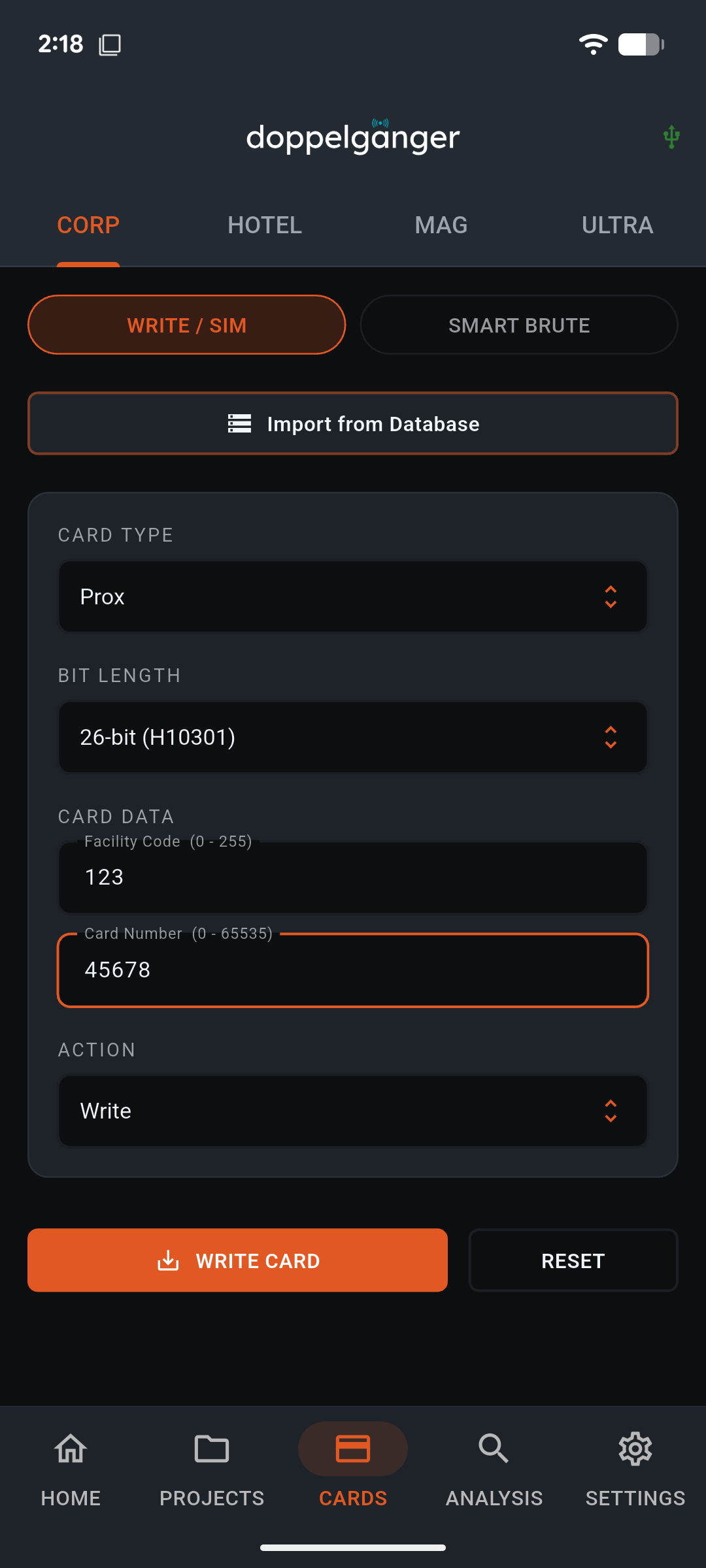
- WRITE / SIM against SMART BRUTE. The first decision, and picking the other one replaces everything below.
- Import from Database, which fills this whole form from a card you already hold.
- CARD TYPE, grouped by radio under LOW FREQUENCY (125 kHz) and HIGH FREQUENCY (13.56 MHz). It decides which fields appear.
- BIT LENGTH, named with its Wiegand format, so 26-bit reads 26-bit (H10301).
- CARD DATA. The ranges in the labels are the real limits for the chosen format.
- ACTION. Write or Simulate Card, with whichever the chosen type cannot do removed.
Choosing a card type
Section titled “Choosing a card type”The picker holds fourteen types in two groups. The group heading is the radio, and it matters more than the brand name, because a 125 kHz credential and a 13.56 MHz credential have nothing in common except the badge they are printed on.
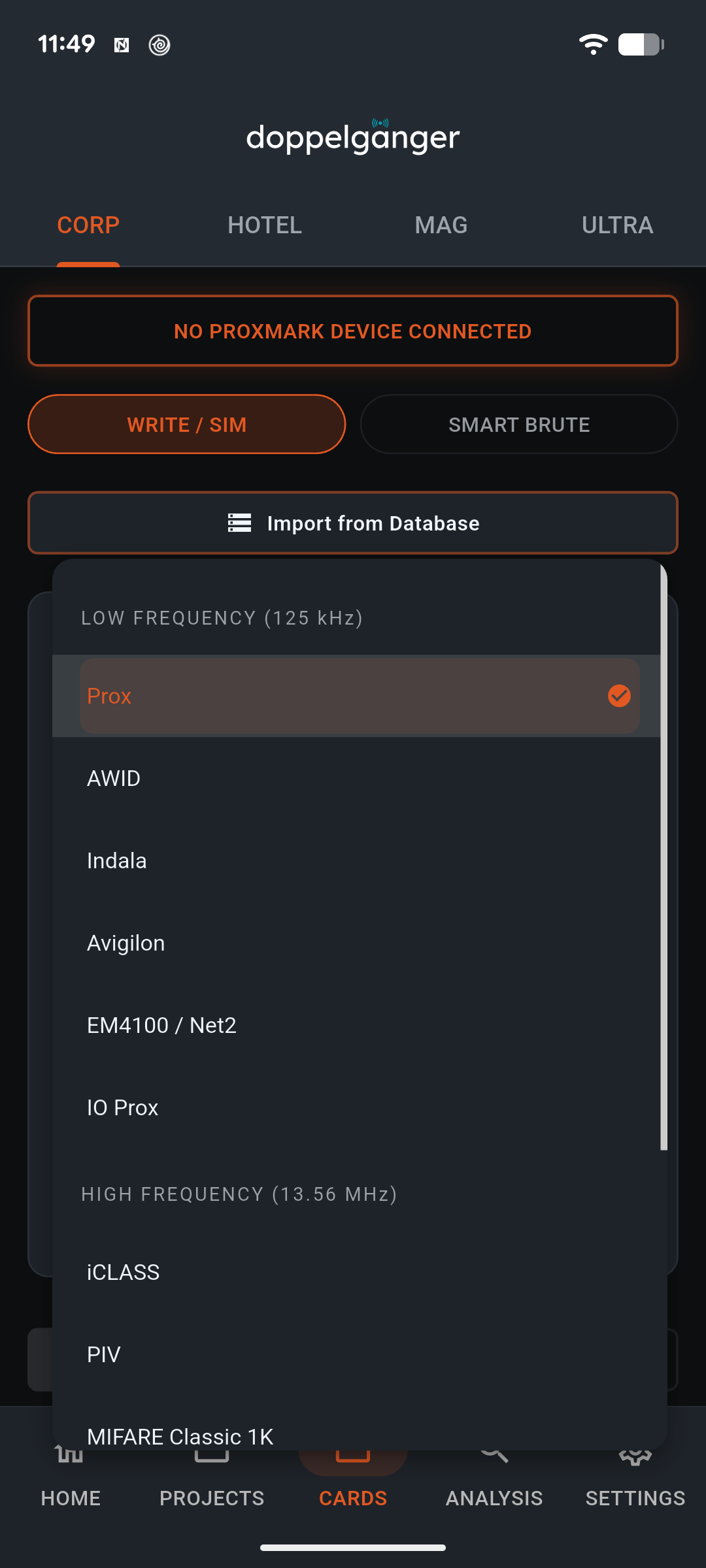
- LOW FREQUENCY, 125 kHz. The group heading is the radio.
- IO Prox, the last of the 125 kHz types.
- HIGH FREQUENCY, 13.56 MHz. iCLASS, PIV and the MIFARE families.
LOW FREQUENCY (125 kHz) carries Prox, AWID, Indala, Avigilon, EM4100 / Net2 and IO Prox.
HIGH FREQUENCY (13.56 MHz) carries iCLASS, PIV, MIFARE Classic 1K, MIFARE Classic 4K, MIFARE Mini, MIFARE Ultralight, MIFARE Ultralight EV1 / NTAG215 and MIFARE DESFire.
What you type next follows from the type.
| The type you picked | What the form asks for |
|---|---|
| Prox, iCLASS, AWID, Indala, Avigilon | BIT LENGTH, then Facility Code and Card Number |
| EM4100 / Net2 | HEX DATA, as ten characters |
| IO Prox | BIT LENGTH, which offers 64-bit (XSF) only, then Facility Code, Card Number and Version. Version is required, and a write without it stops at Please enter Version. |
| PIV and the MIFARE families | CARD UID, as 8 or 14 hex characters |
Choosing a bit length
Section titled “Choosing a bit length”Bit length is offered for the five Wiegand types and IO Prox, and each entry names the format rather than only the number, because the format is what a reader is configured for.
| Type | Bit lengths offered |
|---|---|
| Prox | 26 (H10301), 28 (2804W), 30 (ATSW30), 31 (ADT31), 33 (D10202), 34 (H10306), 35 (C1k35s), 36 (S12906), 37 (H10304), 46 (H800002), 48 (C1k48s) |
| iCLASS | 26, 30, 33, 34, 35, 36, 37, 46, 48, with the same format names |
| AWID | 26 (AWID26), 50 (AWID50) |
| Indala | 26 (Ind26), 27 (Ind27, simulate only), 29 (Ind29, simulate only) |
| Avigilon | 56 (avig56) |
| IO Prox | 64 (XSF) |
If you do not know the format, 26-bit (H10301) is the one to try first. It is the most widely deployed Wiegand format, and it is what the form opens on.
The ranges in the Card Data labels move with the bit length you pick, so a format with more facility code bits widens the field it accepts. Read the label rather than assuming 0 to 255.
They do not climb steadily with the bit length either, because each format splits its frame its own way, so the two maxima jump around from row to row. Here is every pair the form offers, with the numbers the labels print.
| Type | BIT LENGTH | Facility Code | Card Number |
|---|---|---|---|
| Prox | 26-bit (H10301) | 0 - 255 | 0 - 65535 |
| Prox | 28-bit (2804W) | 0 - 255 | 0 - 32767 |
| Prox | 30-bit (ATSW30) | 0 - 4095 | 0 - 65535 |
| Prox | 31-bit (ADT31) | 0 - 15 | 0 - 8388607 |
| Prox | 33-bit (D10202) | 0 - 127 | 0 - 16777215 |
| Prox | 34-bit (H10306) | 0 - 65535 | 0 - 65535 |
| Prox | 35-bit (C1k35s) | 0 - 4095 | 0 - 1048575 |
| Prox | 36-bit (S12906) | 0 - 255 | 0 - 16777215 |
| Prox | 37-bit (H10304) | 0 - 65535 | 0 - 524287 |
| Prox | 46-bit (H800002) | 0 - 16383 | 0 - 1073741823 |
| Prox | 48-bit (C1k48s) | 0 - 4194303 | 0 - 8388607 |
| iCLASS | 26-bit (H10301) | 0 - 255 | 0 - 65535 |
| iCLASS | 30-bit (ATSW30) | 0 - 4095 | 0 - 65535 |
| iCLASS | 33-bit (D10202) | 0 - 127 | 0 - 16777215 |
| iCLASS | 34-bit (H10306) | 0 - 65535 | 0 - 65535 |
| iCLASS | 35-bit (C1k35s) | 0 - 4095 | 0 - 1048575 |
| iCLASS | 36-bit (S12906) | 0 - 255 | 0 - 16777215 |
| iCLASS | 37-bit (H10304) | 0 - 65535 | 0 - 524287 |
| iCLASS | 46-bit (H800002) | 0 - 16383 | 0 - 1073741823 |
| iCLASS | 48-bit (C1k48s) | 0 - 4194303 | 0 - 8388607 |
| AWID | 26-bit (AWID26) | 0 - 255 | 0 - 65535 |
| AWID | 50-bit (AWID50) | 0 - 65535 | 0 - 4294967295 |
| Indala | 26-bit (Ind26) | 0 - 255 | 0 - 65535 |
| Indala | 27-bit (Ind27, simulate only) | 0 - 8191 | 0 - 16383 |
| Indala | 29-bit (Ind29, simulate only) | 0 - 8191 | 0 - 65535 |
| Avigilon | 56-bit (avig56) | 0 - 1048575 | 0 - 17179869183 |
| IO Prox | 64-bit (XSF) | 0 - 255 | 0 - 65535 |
27 pairs, resolving to 17 distinct formats, because every iCLASS entry reuses the Prox format of the same width and Indala 26-bit is written through H10301.
IO Prox has a third box, Version, labeled 0 - 255.
The outliers are the ones to know before you type. 31-bit (ADT31) takes a facility code no higher than 15, where 48-bit (C1k48s) takes one up to 4,194,303. 28-bit (2804W) stops the card number at 32,767, where 56-bit (avig56) carries it to 17,179,869,183. Go over a maximum and the action refuses with the range and the format named, for example Facility Code must be between 0 and 255 for 26-bit prox cards (HID H10301). The range in the label and the range in the refusal are read from the same table, so they are always the same number.
Which blank to use
Section titled “Which blank to use”The card type decides the blank, and putting the wrong one down is the most common reason a write does nothing.
| What you are writing | Put this on the antenna | Why |
|---|---|---|
| Prox, AWID, Indala, Avigilon, EM4100 / Net2, IO Prox | T5577 | the standard rewritable 125 kHz tag. It is what the Proxmark’s clone commands target |
| iCLASS | iCLASS 2K | written with an encode onto a writable iCLASS card using the default key |
| PIV, MIFARE Classic 1K and 4K, MIFARE Mini | Gen1a magic | the UID is the payload, and only a magic card lets block 0 be written |
| MIFARE Ultralight, Ultralight EV1 / NTAG215, DESFire | nothing | simulate only. A 7 byte UID written over a Gen1a’s block 0 lands on the check byte and the SAK, and the card stops answering |
Starting from a card you already have
Section titled “Starting from a card you already have”Import from Database sits above the form on every tab that takes card data. It opens the cards already in your projects and fills the whole form from the one you pick, which is faster and safer than reading a facility code off a dump and typing it back in.
It reads stored records rather than hardware, so it works with nothing connected. That makes it the way to set up before you are anywhere near the door.